Two Kinds of Debris, One Dense Mat
Greensboro gutters do not receive a neat, single-season leaf drop. Pines contribute slender needles across much of the year. Piedmont oaks add catkins and pollen in spring, then broad leaves in fall. The two materials fit together unusually well, and not in a way that helps drainage.
An oak leaf can cover part of an outlet but still leave gaps around its edge. Pine needles thread through those gaps, cross over one another, and hold the leaf in place. More leaves land on top. Fine pollen and roof grit settle underneath. After rain, the loose pile becomes a compact mat that sends water across its surface.
That is the Greensboro double hit: volume from hardwoods and structure from needles.
Pine Needles Do Not Wait for Fall
It is tempting to treat gutter cleaning as an autumn job. That timing may miss the roof under tall pines. Needles can arrive between the larger hardwood cycles, lodging in seams and outlets or sliding beneath open guard screens.
Their shape makes them effective bridge builders. Several needles span a small opening, then catch more pieces. At a downspout outlet, that framework traps catkins and leaf fragments until the exit narrows. The gutter may look only partly occupied while the most important point is nearly closed.
Needles also settle into low sections. If a gutter holds even a shallow pool, the wet material stays put and captures grit. Repeated cleaning will not solve that low spot if pitch or support is the real cause.
Oaks Begin Their Gutter Cycle in Spring
Oak catkins are the dangling flower clusters that later fall in light, curled pieces. Dry catkins blow easily. Wet ones clump, bend, and wrap around obstacles. The top of a downspout is an ideal collection point.
Pollen adds the yellow-green coating familiar on vehicles and outdoor furniture. The same film lands on roofs and washes into gutters. It does not create a large clog by itself, but it fills the small spaces between needles, catkins, and grit. The mass drains more slowly and holds moisture longer.
A spring inspection therefore has a different purpose from fall cleaning. It looks for fine material and outlet restrictions before the first round of hard summer storms.
Fall Adds the Blanket
Broad oak leaves bring the visible volume. Some blow out of an open gutter when dry. Many become pinned by needles or lodge in a valley before sliding to the eave. A wet leaf lying flat can cover a screen or outlet like a temporary lid.
Waiting until the entire leaf cycle finishes may be reasonable for an open roof. On a heavily wooded property, a mid-cycle mat can sit through several rains. The right timing depends on whether water is still reaching the downspout, not on whether the last leaf has fallen.
What Guards Can and Cannot Do
Open screens are useful against broad oak leaves but allow many needles through. Fine mesh is better at excluding slender material, yet its surface can collect pollen film, flat leaves, and needle bundles. Water from a roof valley may ride over a loaded surface rather than enter.
That does not make guards useless. It means the selection must follow the debris and maintenance plan. The gutter guard guide compares common openings and explains when an uncovered run may be simpler.
A Practical Cleaning Sequence
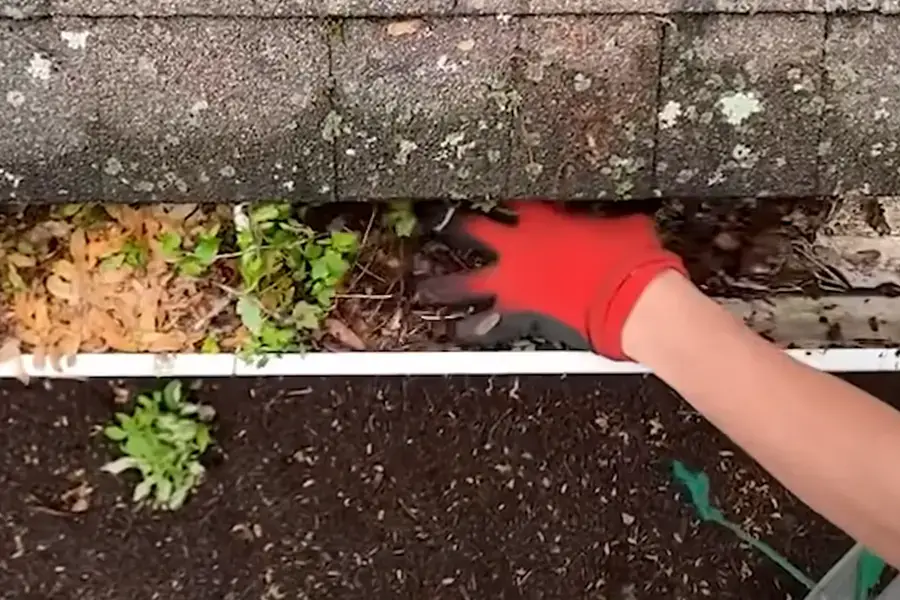
Begin by removing the broad upper layer without pushing it into the outlet. Work through the needle mat and expose the gutter bottom. Clear the outlet carefully, then confirm that the downspout and extension have an open route. Finally, observe whether the empty run holds water or reveals a weak seam.
For taller eaves, steep grade, wet clay, or electrical proximity, stay on the ground. The professional cleaning page explains what a full drainage-path check should address.
The double hit is manageable when each material is understood. Watch spring catkins, do not ignore needles between seasons, and use fall leaf volume as one part of the schedule rather than the whole calendar.